
Design story
Smart Street Furniture: when the bench becomes infrastructure
How sensor-equipped seating, tested on the streets of Paris, helps people find a seat and helps cities understand public space.
By Lionel Scharly · October 2026 · 6 min read
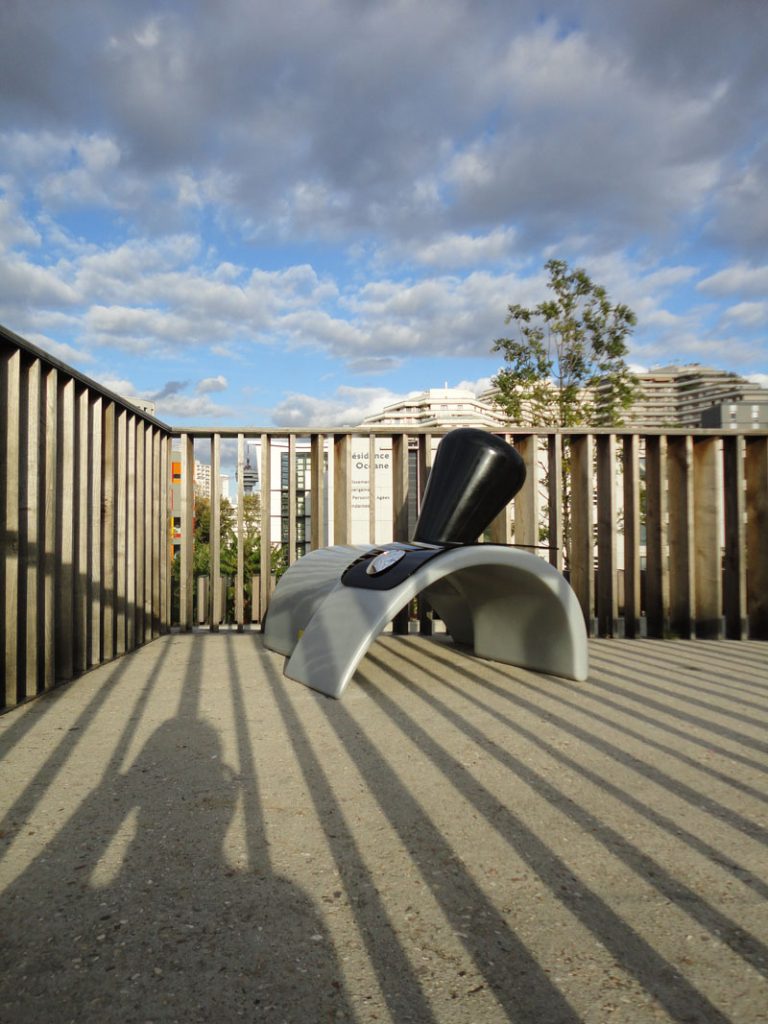
The public bench is the oldest piece of civic furniture there is, and for most of its history it has not changed: a plank, a frame, a place to rest. Cities install thousands of them and know almost nothing about how they are used. Smart Street Furniture starts from a simple question — what if the seat could tell you whether it is free, and tell the city how the street is really used?
The story behind Affordance
The idea began at an event at Microsoft’s European headquarters, where Lionel Scharly met a well-known tech entrepreneur and investor. The next day, the investor invited him to lunch in a very simple, singular Japanese restaurant — and made an unusual request: make the furniture talk.
Rather than giving the furniture a voice, Lionel Scharly began to think about the interaction between people and machines. He went back, in his mind, to a place he knew well from his years as a student at the École nationale supérieure des Beaux-Arts de Paris: the Jardin du Luxembourg, where he used to study. The garden was full of people sitting side by side on its chairs, and almost no one spoke to each other.
That silence became the brief. Instead of a talking bench, he set out to invent smart street furniture that could create a connection between people, with the machine as the go-between. A former student of Ted Nelson — the computing pioneer who coined the word “hypertext” — he named the project Affordance.
A seat that talks back
Smart Street Furniture is the idea behind Affordance, the line of intelligent seating designed by Lionel Scharly and Scharly Designer Studio. Each seat carries a small sensor that knows when someone is sitting on it. That information goes to a phone, so a passer-by can see which seats nearby are free before walking over to them.
For the person on the street, it turns public seating into something you can find, like a bike share or a bus. For the city, the same data shows which spaces people actually use, at what time of day, and which ones they avoid.
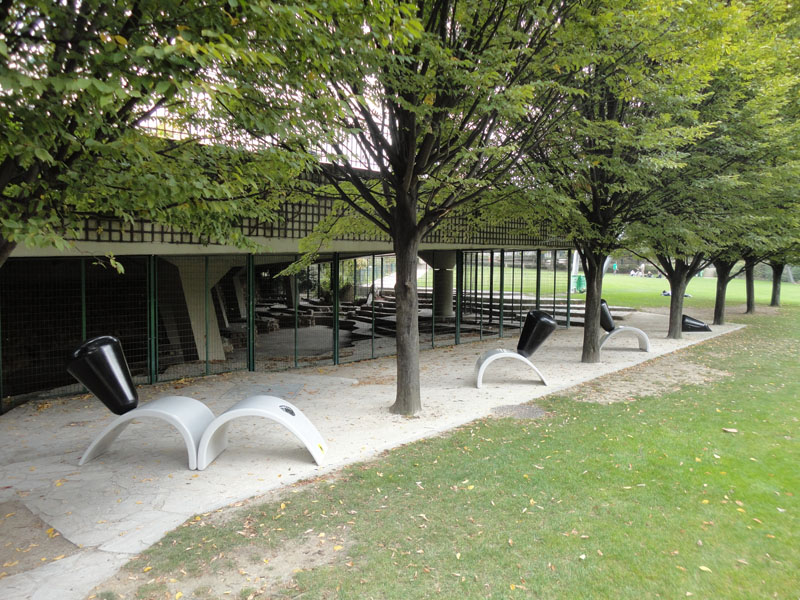
Tested on the streets of Paris
In 2010 the City of Paris launched Mobilier Urbain Intelligent, a call for projects asking designers and companies to imagine street furniture for the connected city. Around fifty proposals came in, and in April 2011 a jury selected forty of them. The prototypes were installed in public spaces across the city from late 2011 into 2012, each for six months to a year, so Parisians could use them and the city could see what worked.
Our seats were among them. Press coverage of the program described them as contemporary seats fitted with sensors that show available seats on a smartphone. They sat in parks, on footbridges and in public squares — the places in this article’s photographs — and were used every day by people who had never heard of them.
Built to live outdoors
Street furniture has to survive weather, sun, vandalism and constant use, and it has to be made in quantity. The Affordance pieces are rotomoulded: plastic is turned inside a heated mould until it forms a seamless, hollow shell. One mould produces a complex, ergonomic form in a single piece, with far fewer parts to assemble, break or replace than a conventional bench.
The process is protected by a patent for rotomolded ergonomic furniture, filed in 2009 by Scharly Designer Studio and published internationally in 2010 (WO2010109080). The shells are made from eco-friendly plastic, and the hollow body leaves room inside for the sensors and electronics.
Why it matters for cities
Cities around the world are now putting sensors into street furniture. In New South Wales, Australia, a Street Furniture Australia project with Georges River Council has fitted tables, seats and bins with sensors that track how they are used and report faults in real time. The lesson from these projects is the same one Affordance was built on: seating data helps planners move benches that nobody uses, find spaces that fail children or older people, and add seating where it brings people — and business — back to a street.
Good public space is not only about technology. A seat still has to be comfortable, beautiful and in the right place. The sensor simply lets the city learn from the people who use it.
The Affordance pieces
| Single | A compact one-person seat with a carved backrest. View Single |
|---|---|
| Single Round | The round edition of Single. View Single Round |
| Twins | The award-winning pair, shown at Observeur du Design 2012. View Twins |
| Frankfort Factory | The collector edition, last of 50 samples. View Frankfort Factory |